Representatives from AEC recently had the pleasure of touring Schneider Electric’s Innovation Hub in Andover, Massachusetts. It is one of the company’s five global research and development centers and serves as a flagship location for showcasing advances in energy management and automation. Located within a 53,000‑square‑foot R&D campus, the facility features more than 40 specialized laboratories focused on industrial automation, building systems, data centers, and microgrid technologies. The site also acts as a major innovation and testing hub where real‑world systems are demonstrated using Schneider Electric’s EcoStruxure™ architecture. Engineers, partners, and customers can see fully operational solutions, not just simulations, spanning power, IT, and operational technologies.
While we were there, we saw some history: a Modicon 084 modular digital controller (aka PLC). This is credited as the first programmable logic controller. According to our guide, the only other Modicon 084 available for public viewing is at the Smithsonian Institution in Washington, D.C.
The First Programmable Logic Controller:
The Modicon 084
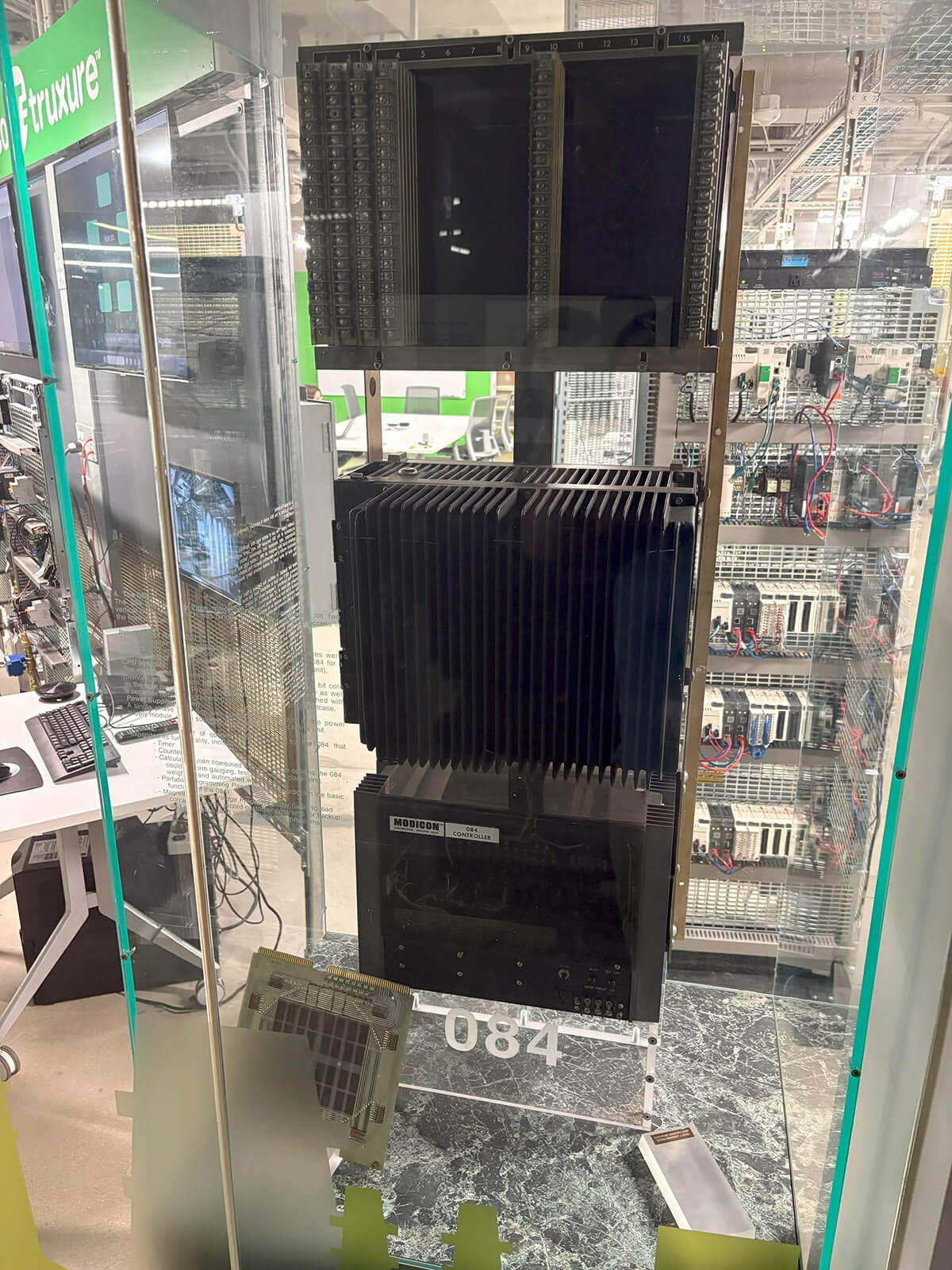
In the late 1960s, manufacturers faced a growing problem: production lines controlled by massive banks of electromechanical relays were difficult to modify, expensive to maintain, and time‑consuming to troubleshoot. In response to a request from General Motors for a more flexible control system, engineer Richard “Dick” Morley developed what became the world’s first programmable logic controller (PLC) in 1968. That device was the Modicon 084, and it would permanently change industrial automation.
The Modicon 084 (short for Modular Digital Controller) was designed to replace relay logic while remaining familiar to electricians and engineers. Instead of requiring rewiring, control logic could be changed in software, using ladder logic that closely resembled relay diagrams. With modest specifications by today’s standards—16 inputs, 16 outputs, and about 1 KB of memory—the Modicon 084 nevertheless delivered revolutionary flexibility, dramatically reducing downtime and enabling faster changes on automotive assembly lines.
From Relay Replacement to Industrial Backbone
Throughout the 1970s and 1980s, PLCs rapidly evolved beyond simple relay replacement. Memory capacity increased, processors became faster, and PLCs gained functions such as timers, counters, analog processing, and networking. Modicon controllers were widely adopted, helping standardize ladder logic as a common programming language across the industry. As microprocessors matured, PLCs became compact, rugged industrial computers capable of controlling increasingly complex manufacturing processes.
Modicon itself grew alongside the technology, expanding its product line and influence. In 1996, Modicon was acquired by Schneider Electric, marking a major milestone in the brand’s evolution. PLCs went on to integrate with supervisory control and data acquisition systems (SCADA), distributed control systems (DCS), Ethernet networks, and enterprise software—becoming a foundational element of modern automation architectures.
Modicon Today
Today, Modicon lives on as a flagship automation brand within Schneider Electric. Modern Modicon PLCs—such as the Modicon M340, M580, and M262 families—support advanced motion control, cybersecurity, industrial Ethernet, and direct integration with digital platforms and Industry 4.0 initiatives. What began in 1968 as a practical solution to relay cabinets has become a cornerstone of modern smart manufacturing.
More than five decades later, the Modicon 084’s legacy remains clear: the PLC didn’t just improve factory control—it changed how industry thinks about automation.
For over 40 years AEC Engineering has been New England’s premiere provider of custom designed-and-built UL listed control panels, PLC programming, SCADA software design and programming services, and reliable service & support for all your automation and integration needs. Our fabrication shop is certified UL 508A, 698, and NNNY. Contact us today to learn how AEC Engineering can help you with your next project.